
 on Yellow Dog Records and carried home the 2009 Blues Music Award for Acoustic Blues Album of the Year. Her latest CD, Ain't Got No Troubles
 , promises more of the same next spring around Awards time. We're grateful that the gracious Ms. Brent took the time to answer a few questions for us.
1. Your latest CD, Ain't Got No Troubles
, introduced some New Orleans sounds into the mix with fantastic results. What encouraged you to go in that direction? I am hoping that each new recording can be a new adventure. In the past, I never considered myself a recording artist anyway. Rather than making tours to promote records, I started making records so I could tour. I've felt pretty comfortable on the stage for years. I didn't feel very comfortable at first in the studio, but even though I've only recorded three albums, I feel like I've learned a lot in those three sessions. Plus seven years have elapsed.
Mississippi Number One
was very warmly received, and I felt under a bit of pressure to make something new that critics and listeners could be happy and surprised and delighted by again, in the same way that they seemed to be by Mississippi Number One. I had been searching for a producer to help make this record so I could achieve the freshness I was looking for with this record. Bill Wax introduced me to Colin Linden at Marcia Ball's show at Alfred's the day after the 2009 Blues Music Awards in Memphis. The introduction was brief and polite, and I was aware of Colin's work, in particular the two albums he had produced for Janiva Magness. I emailed Colin to ask him if he would be interested in working with me. He replied, "Eden, I would cart-wheel through the streets of Memphis to make a record with you." When he said that, I knew he was the producer I wanted to work with. Colin gave me a few suggestions for studios, and Piety Street in New Orleans just seemed to be the one that would reflect the music I had written for this album the best. The title cut, "Ain't Got No Troubles" would have lost a little something without the New Orleans flavor. The carefree presentation of the melancholy is a recurring juxtaposition in blues and is probably presented most effectively in New Orleans, just like the light-hearted music that follows hymns at a New Orleans style funeral. ("Just A Closer Walk With Thee" followed by "When the Saints Go Marching In.") The other recordings I've done were in Memphis, and Memphis feels like my backyard. While I feel fairly comfortable in New Orleans, it is not as familiar as Memphis. I believed that recording in New Orleans, a city just down from Memphis and my home Greenville on the Mississippi River, would encourage that freshness I sought. I was right. Plus, like Memphis, musicians are plentiful in New Orleans and definitely qualified, some of the best in the world.
2. In what other directions do you see your music going in the future?
In music, the greatest blessing and the greatest curse are the same thing: the sky is the limit. Because there is no end to the journey, musicians are in a constant state of agitation, always trying to achieve. At the same time, musicians are in a constant state elation, continually achieving. Music (and all art forms) are the only career pursuits that I can think of where there is no top, like becoming president or the CEO. Even if I win 100 Grammys or sell 50 million records, I cannot stop striving to achieve better musicianship, more skilled songwriting, more dexterity on the piano, or more vocal clarity. I played briefly years ago in an Allman Brothers tribute band. That experience helped me grow as a musician because the style was so vastly different than the kinds of music I had been performing, jazz and blues. I would love to collaborate with more musicians of different genres. I would thrill at the opportunity to work with just about anyone, reggae musicians or country musicians. I enjoy all kinds of music. There is no genre that I dismiss, and most are valuable forms. I would enjoy the opportunity to cross over somewhat into some other genres with which I am less familiar than blues because I know that it would improve my overall musicianship. For instance, one of my lifelong goals is to make a "world record." I would love to make a record with people from around the whole world, each of us bringing our own style to the recording. Whatever direction the music goes, I am assured I will be striving for better musicianship.
3. You're from a musical family.....even recorded a few of your mom's songs for Mississippi Number One
......when did you know that you were going to have a career in music? I wanted to be a musician from the time I was a small child, at least by the third grade but probably before that because I don't remember when I didn't want to be a musician. I was trying to play the piano by about age three and was in lessons by age five. I was not sure even as a young adult that my career would be nearly exclusively as a performer or entertainer, but I knew I would be a musician and that music would be my career, whether as a rock star, or a teacher, or an ethnomusicologist. And I always knew that I would perform and entertain, even if it weren't my primary means of income. I performed in nursing homes and talent shows and at family parties since grade school.

I knew of Boogaloo from parties and receptions and restaurant lounges since I was a young teenager. He played the reception when I christened the M/V Eden Brent, a towboat built and operated by my family's company, Brent Towing. At that time, it had never occurred to me to be an apprentice. At that time I thought that an apprenticeship was an antiquated form of learning from history books, like learning to be a blacksmith. I would go to hear Boogaloo and request songs like "Don't Get Around Much Anymore" or some of the old standards. During my freshman year of music school at The University of North Texas, I was studying jazz and unsuccessfully. I did not have an adequate background in jazz to absorb the jazz education that UNT was presenting me. At that point, sometime during my freshman year, I asked Boogaloo to teach me. I knew that I would benefit from his knowledge and the one-on-one atmosphere of learning from a private teacher. Boogaloo agreed to teach me, and we worked together during all of my college breaks, Summer, Thanksgiving, Christmas, Spring, and so forth. I even took about a year off from college during my third year there, and Boogaloo and I worked together then, too. He taught me well enough that during the summer of 1986, when Boogaloo was working in Jackson for a month, I took his job at his local happy hour gig. I made $30 a night, half of what he was making at the time, and I did not work everyday as he had been, but it was my first gig. I eventually graduated from UNT with a bachelor's degree in music theory. When I returned home, I studied with Boogaloo more regularly and began sitting in with him at some of his gigs. At first, I would sing a song or two. Eventually, people started hiring us together. By 1990, we were becoming a known duo on the local scene and remained together until his death in 2002. I continued to take lessons with him throughout, and toward the end of his life, really made huge efforts to try to get Boogaloo the recognition that he deserved. I nominated him for and he received the Mississippi Arts Commission's Folk Art Fellowship and the Governor's Award for Excellence in the Arts. It was thrilling to see him celebrated during his last years.
Sadly, Boogaloo Ames only recorded a few times before his death. Here's his version of "After Hours," from the 1999 anthology set, From Mississippi To Chicago
 .
.5. Who are your biggest influences as a composer?
Naturally as a pianist, I am enthralled with the greats of the classical idiom: Bach, Schubert, Brahms, Beethoven and Mozart, among others. In the realm of popular music, I admire Cole Porter, George Gershwin, Duke Ellington. Richard Rodgers, all the composers of the standards. But to acknowledge them, I have to also acknowledge the lyricists who worked with some of them, Ira Gershwin, Oscar Hammerstein and Lorenz Hart. I love Hank Williams, too. I admire and strive to make songs with memorable melodies and simple, clever and meaningful lyrics. Cole Porter is one of the all-time greats at both melody and lyric writing. As a youngster, I enjoyed the work of Kris Kristofferson, Joni Mitchell, James Taylor and Jackson Browne. Currently some of my favorites songwriters are John Hiatt, John Prine, Eric Bibb, Anders Osborne and Malcolm Holcombe. Actually, it is very difficult to name all of my favorites because there are so many.
6. Of the songs that you've written, which ones are your favorites?
From my first album, "South Africa" is a favorite of mine and often requested, and "Simple Geometry" was written as a kind of tribute to Cole Porter. "Mississippi Number One" is a very catchy tune, and "Until I Die" is a pretty ballad from that album. On the current album I giggle at the double entendre in "My Man", but "Leave Me Alone" and "Ain't Got No Troubles" are really my favorites. Of all the songs I've ever written, "Ain't Got No Troubles" is really melodically and lyrically my masterpiece to this date. The melody is very simple and tends to play over again in your mind after you hear it and the lyrics suggest the melancholy of the song in a playful, lighthearted way.
7. Who are your biggest influences as a singer and on the keys?
Naturally Boogaloo is my greatest influence on piano. Every musician I hear, no matter the instrument, influences me to some extent. I've listened to loads of singers both male and female: Nat King Cole, Ella Fitzgerald, Billie Holiday, Bessie Smith, Dinah Washington, Little Jimmy Scott, Chet Baker, Nina Simone, Betty Carter, Aretha Franklin, Etta James, Al Green, Sarah Vaughn. In the recent blues market, two of my favorites are Reba Russell and Janiva Magness. Both of them have such beautiful vibrato. One of the best pianist/singers is Di Anne Price from Memphis. She is truly wonderful, and her playing reminds me sometimes of Boogaloo. I still listen to her to try to learn something.

8. What are the most memorable and most forgettable gigs that you've ever done?
Playing at the Kennedy Center with Boogaloo was really something, and the tune I sang with him at the Governor's Award for Excellence in the Arts was memorable. Participating in the IBC was memorable, both in the semi-finals and the finals. Lots of people remember my winning set there because the piano had a short in it and went out. That same thing has happened to me a few times since. Some of my gigs have been ones that I had dreamed of or hoped for many years, playing the WWOZ Piano Night during the New Orleans Jazz Festival, performing the Blues Music Awards right after winning my first two Blues Music Awards, playing the Chicago Blues Festival. I still have many dreams yet to come true, and I look forward to them. Some of the gigs that are expected to be great turn out mediocre, and some of the gigs you expect to be blasé are actually wonderful. I played a gig at 930 Blues Café in Jackson a few years ago. The house band was Smoke Stack Lightning's band. I remember as I was walking up the stairs to the gig, Smoke Stack and I met and looked at each other up and down, each of us thinking, "Uh, oh. Here comes trouble." I could tell by the look on his face that he was thinking the same thing as me, well, nearly. He was saying to himself, "What is this white girl going to be able to do with us?" And I was asking myself, "What are these cats going to be able to play with me?" The wonderful thing is, from the first bar of the first tune, he and I looked at each other with such delight, and the music was magical that night. There are many memorable gigs. The forgettable ones I fortunately forgot!
9. What are the best and worst things about being a musician?
The best things about being a musician are that I get invited to places I would not ordinarily be invited to, like performing at the Governor's Mansion. It's very easy to meet friends. I can continue to achieve and don't have to take a mandatory retirement. I am often allowed to drink on the job. I get to hang around with other musicians. I love traveling to new places and meeting new people. The worst things about being a musician are that I am driven to continue to achieve and I cannot take a mandatory early retirement. (I mentioned this idea before---the blessing is the curse.) I don't get to attend many shows so I can't often hear music unless I'm on the Legendary Rhythm & Blues Cruise, The Blues Music Awards, The International Blues Challenge, or a festival show. On these occasions, I revel at the opportunity to hear the other acts. Sometimes being on the road can be a little lonesome, but all in all, I wouldn't trade it for anything.
10. What does your record collection look like? What music do you take with you on the road?
I listen to all sorts of music. The least in my collection would be hip hop or country records. I have not bought much of that in the last years. In fact, I rarely buy music anymore from people that either aren't dead or I have not seen in concert before. I love classical music, jazz, soul, rock, nearly everything. Lately I've been listening to Janiva's new record, The Devil Is An Angel Too
 and Reba Russell's new one called 8
 . I listen to a good bit of Southern Soul Blues like Tyrone Davis and Bobby Rush and Denise LaSalle. These are the kinds of Blues acts I grew up with. On the road I have my computer, and it is full of great music of all genres so in my hotel I have good music.
 Eden Brent - Discography
 |
| Something Cool |
 |
| MississippI Number One |
 |
| Ain't Got No Troubles |


 , but it's sort of turned upside down from his previous efforts. The difference is that Randolph covers more music from other artists, paying tribute to his "roots," if you will. When Randolph was growing up, he was only allowed to listen to gospel music. As he grew older, he became exposed to other music, most notably the blues via Stevie Ray Vaughan and other modern masters. Randolph traced this music back to the source and discovered other artists, like the incredible Blind Willie Johnson, whose "If I Had My Way (I'd Tear This Building Down)" gets an amazing face lift, as Randolph and guest guitarist Ben Harper nearly tear the building down themselves. There are some other great moments as well, including Bob Dylan's "Shot of Love," Peter Case's "I Still Belong To Jesus," and a really cool take of Prince's "Walk Don't Walk." So, yeah it's different from his previous releases, but in a good way and I have to admit that I'm still listening to this one after several months and still finding things about it that I like.
 and it's loaded with great urban blues with a great mix of Memphis and Chicago blues. Haddix also offers a pair of excellent acoustic tracks, one of which is a tribute to his father, Chalmus "Rooster" Haddix, who was a Delta guitarist and performer in the Robert Johnson tradition. If you're a fan of cool urban blues, you'll love Travis "Moonchild" Haddix. Check out this clip of the title track from his recently released companion DVD.
 , features 15 performances from some notable blues artists, including Koko Taylor, Little Milton, Robert Lockwood, Jr., Eddie Clearwater, Pinetop Perkins, Dave Riley, Henry Gray, Carol Fran, and Louisiana Red. Among the notable tracks is Lockwood's only recording of "That's All Right," a song that he claimed to have written many years ago. Corritore provides some wonderful harmonica backing on all the songs, stepping out front for the instrumental "1815 West Roosevelt," with sax man Eddie Shaw. It's hard to go wrong with any of Corritore's releases. You're guaranteed some fantastic music from an outstanding group of musicians. This is a wonderful addition to his catalog. Don't miss it. Check out Corritore with his long time running partner, Dave Riley from a 2008 appearance in France.
 . It's a sequel of sorts, reprising two of Walker's most acclaimed releases, the two-disc
  set from the early 90's, and his
  release from the mid 90's, which featured JLW with many of the guitar-playing legends of the blues. Here, you get the best of both worlds, with Walker appearing live at the 2010 Legendary Rhythm & Blues Cruise with some of the biggest names in the genre, including Johnny Winter, Duke Robillard, Tommy Castro, Kenny Neal, Watermelon Slim, Tab Benoit, Kirk Fletcher, Nick Moss, and many, many more. Walker never disappoints in his performances and is coming off a Blues Music Award for Album of the Year. He graciously shares the stage with these other artists, who give some impressive performances of their own on a mix of JLW favorites and some choice covers. If you haven't been on one of the blues cruises, this could be the next best thing to being there. Enjoy this clip from the 2010 LRBC, and one of the songs from the new disc, featuring JLW with fellow guitarists Duke Robillard and Todd Sharpville performing "Tell Me Why."


 , in 1990.
 ,
,  , didn't meet the expectations of it's predecessor, a formidable challenge, though it did include some nice moments, including Ward’s own interpretation of “I Found A Love.” His third release, 1995's
  , was much better, with some new compositions by Ward and more of that great guitar. Check out "Lonely Man," from
 that was a little rawer than his Black Top recordings, with fewer horns. Ward also brought some new songs to the table that ranked with his best, including the powerful “Peace of Mind,” and a sharp instrumental, “The Chicken Jerk,” that features some funky fingerpicking. Lots of Ward's later material veered toward the gospel side with inspirational lyrics and messages, often sung with his second wife Roberta, who also co-authored several of his later songs.
 , a collection of all his 60’s work as a solo, with the Ohio Untouchables, and with the Falcons. It’s as good as this kind of music gets.
 . Lack of employment and the struggle of raising a family led Waters to make the move north to Chicago, where his dreams of being a musician were rekindled as he formed a powerhouse band in the late 40’s.

 ) and, later, in an ill-advised foray into psychedelic music, entitled
  . Here's a clip of Waters at the Newport Jazz Festival in the early 1960's, performing one of his classics, "Rollin' Stone," and, yes, Brian Jones named his band after this song.....maybe you're familiar with them.
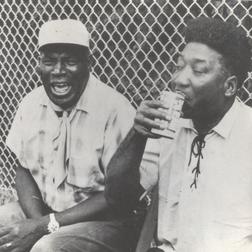
 . One of the originals Waters brought to the session was “The Blues Had A Baby.” The backing band included Winter (who produced the Blue Sky albums) on guitar, Pinetop Perkins on piano, and Cotton on harmonica. Though Waters was now in his 60's, his new recordings were every bit as powerful as his Chess sides.
 , or
, or 
 , a 2-CD set. Several of his Chess albums are still available, too, like
  , and
, and  . For his early recordings in Mississippi, check out
  . Most of his 70's recordings are still available too, like
  ,
,  , and
, and  .
.